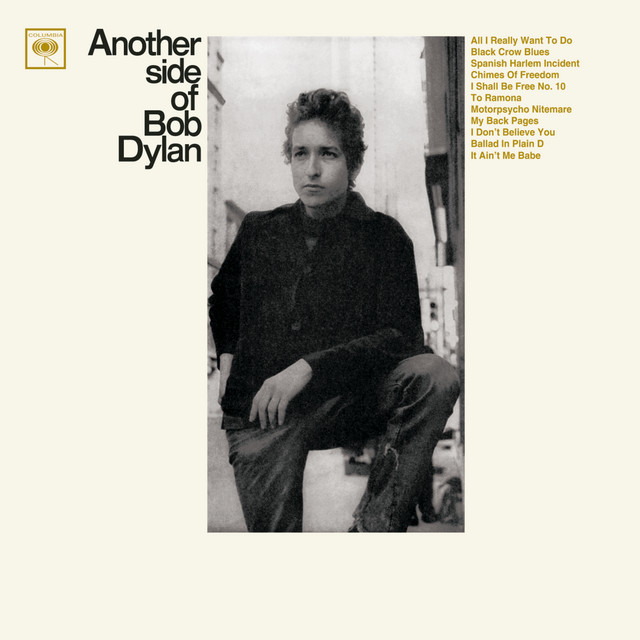
Another Side of Bob Dylan - Bob Dylan (1964)
I came across Bob Dylan after taking a liking to the tune All Along The Watchtower, after hearing a couple different versions of it in a short timespan (a few more details here if you’re interested). Within a couple of months, studying Dylan’s life and music had consumed my life the way it does when you’re a neurodivergent teen music fanatic with few friends or hobbies. His music has been my constant companion for nearly 40 years now, and while he comes and goes from my daily listening, his music and his humor and his unique artistry are always informing my mental landscape.
I’ve written about Dylan records a dozen times or so in the years of this blog, but I haven’t wanted to just drop a random Dylan record into this Substack era without giving it some context. So this week, I’ve chosen 7 records from throughout Dylan’s catalog to show you. None are necessarily his best, nor are they necessarily my favorites. But part of the attraction of Dylan’s work, for me, is its staggering breadth: He’s spent the years re-inventing himself over and over again in sometimes clever and sometimes infuriating ways, and you can’t form an appreciation of the man without acknowledging its diversity.
Dylan, the super-successful folk singer who was straining against the folk revival’s limits
Dylan had become famous on the dual strengths of his elegant protest anthems and the chart-topping pop tunes he’d penned mostly for other artists.
But protest music (a tradition in and of itself) and the pop tunes (he says in his memoir that these came from dissecting Hank Williams tunes to see how they worked) were just two of dozens of styles of song he’d been mining for new material.
By 1964, he was looking for a way to show the world something besides what they expected. He had his producer, Tom Wilson, roll tape one night and pounded out this entire batch of songs he’d been working on in one shot. The social conscience anthems are still here (in My Back Pages and especially Chimes of Freedom), as are some of his finest radio-friendly broken heart hit-making in To Ramona and It Ain’t Me, Babe.
He looked backwards to the rough and rowdy music he’d established himself with. The talking blues style of I Shall Be Free No. 10 and the hillbilly musings in All I Really Want To Do each could have belonged on that first self-titled record that only sold a few thousand copies before he’d become a celebrity.
But we also get glimpses of what was to come. My Back Pages was a template for the “turntable literature” epics that would occupy the second side of Bringing It All Back Home the following year. The folksy country sound of Black Crow Blues was what he would retreat to a few years later while hiding from his fame in upstate New York. Motorpsycho Nightmare is both musically similar to what he’d do with his rock band and lyrically a showcase for his weird, dark, dirty sense of humor without having to hide behind the “folk jester” persona he’d used in the past.
So you can take this record or leave it on face value. Some good songs, some not very memorable ones. But it fits into the catalog as an augur of what was coming in 1965, when Dylan would use his fame and his skills to turn the world of pop music upside down.