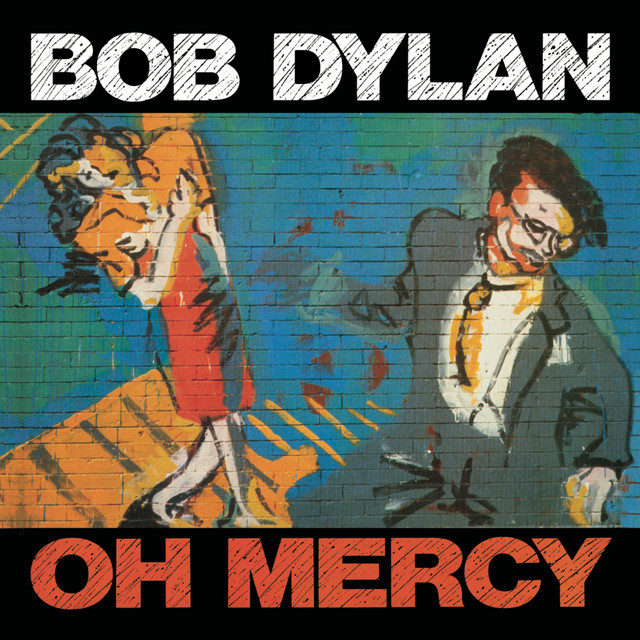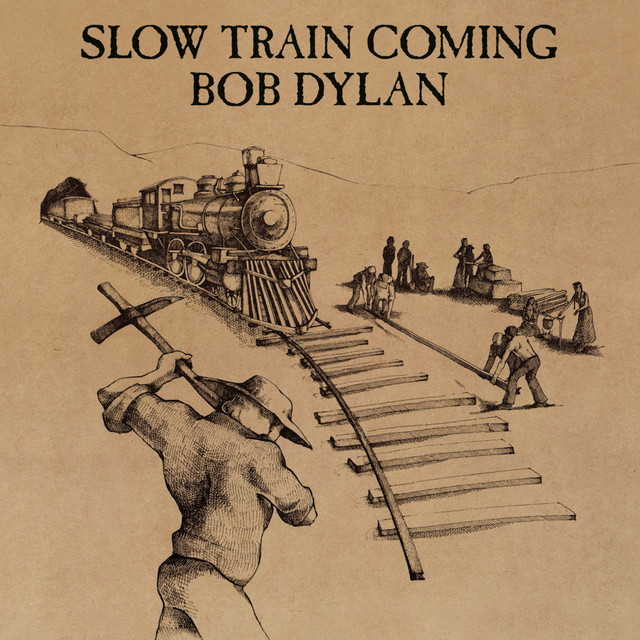
Slow Train Coming - Bob Dylan (1979)
This is going to be a long one. If there’s one thing I like to ruminate on, it’s my love of Bob Dylan’s music. If there’s a second thing I like to ruminate on, it’s the contrapuntal way fundamentalist Christianity forged me, raised me, twisted me, defined me, and enriched me. Dylan’s “Jesus era” is an intersection of these topics in a way that not much else is.
Dylan was Jewish by heritage, but by most accounts was not particularly devout. He immersed himself in American music and folklore, which is definitely Christian in nature. Part of what makes it interesting, and part of what Dylan explored, is all the ways the Christ story is co-opted, adapted, undermined, and recontextualized in various parts of the American experience.
Somewhere in the late 70s Dylan became heavily involved with a gospel organization called the Vineyard Fellowship, which taught the salvation story as well as the prophecies of the New Testament and why it was all about to come to pass and Jesus would return any minute. The late 70s was probably a good time to take an interest in eschatology, with war and rumors of war and nations rising against nations and famines and whatnot (I wouldn’t really know: I was 5 years old). I suspect this intersected with Dylan’s highly acute observations of how faith and the metaphysical work in tandem with actual events to shape our perception of reality.
In 1978, Dylan had what’s referred to as a “conversion experience.” He claimed that he was visited by Jesus and was healed. This isn’t exclusive to Christianity by any means, although it’s a foundational part of the anabaptist tradition of the faith in which I was raised.
I had a conversion experience when I was 9 years old. Before I could be baptized, I had a series of meetings with our pastor so that he could sort out if I really knew what had happened to me. One of the things I often ponder in my life is what that experience meant, really. It was a genuine experience where I felt the spirit of God moving in me. But I know now that it was also exactly the thing that I knew was expected of me by literally everyone in my life in order for me to be taken seriously as a person. So it was both geniuinely manufactured by my environment, and genuinely transformative to me personally. Does that make accepting Christ an authentic choice? What can “authentic” even mean if you’d spent your whole life (all nine years of it, in my case; admittedly, that complicates things) being taught that you should and would choose it? It’s hard to even describe if you haven’t had something similar happen to you.
I expect Dylan had similarly mixed feelings. But one of the things that one is taught to do when this happens–and this isn’t just in the Baptist church, but with a conversion moment in many wisdom traditions–is to double down. I, like Dylan and like the adults in my life, started to view the world as a binary. What I’d been before my choice was separate entirely from what I was after. God saves, the Devil condemns. God’s kingdom is separate but attainable. The Devil owns everything else. There are two things in life: what is holy, and what distracts you from what is holy.
This is some of the context around when Dylan showed up at Muscle Shoals studios in Alabama to record the batch of songs he’d been working on in the previous few months. The resulting album is a musical triumph, one of his best-sounding and best-recorded. It was also a massive shock to a world that had come to see Dylan as a sarcastic social critic who’d seemed to make a folk religion out of not taking things too seriously. Here he was, tackling a subject he took more seriously than most could imagine, and betting his entire career on it.
The band he recorded with featured Muscle Shoals regulars, session players, and Mark Knopfler and Pick Withers of Dire Straits. It was an excellent collection of musicians and producer Jerry Wexler orchestrated everything to perfection.
But like many Dylan albums, it’s hard to separate the musical excellence from how the lyrical content speaks to you. That part is much murkier for most people because of the Christian preaching, and the particular brand of Christian preaching about moral uprightness and spiritual warfare and God bless America make that even more complicated.
According to this worldview, you cannot serve two masters. Gotta Serve Somebody lays this out explicitly at the start of the record, while the following Precious Angel makes clear the implications for living that life.
Part of the weirdness of this era is on Slow Train and When You Gonna Wake Up, where you get a glimpse into the roots of the modern Christian nationalism movement. If there’s only one way to view the world, then why not economize by making that one way the law of the land? Abe Lincoln is equated with God, Karl Marx is equated with the Devil. As with most any political ideology, it’s clearly the best choice as long as you aggressively ignore all the obvious reasons it’s a terrible choice.
For me, the best example of the tightwire act of this line of belief is laid out perfectly in Do Right By Me Baby, and laid out so specifically that it’s why I’m convinced Dylan understood the trade he was making. Equanimity–in his own lyrics, not shooting nobody, not judging nobody, not treating people like dirt–is easy when you can be confident that all that judging, shooting, burning, and defeating will all be done by the God you serve when he comes back and punishes everyone who wasn’t with you. So ultimately there’s a bit of a sick joke implied in doing unto others as you’d have them do unto you. What was supposed to be an exercise in faith becomes an exercise in patience, waiting for retribution rather than actually treating people with expensive grace.
In my 20s–after having met a lot more of the people who were supposedly going to be punished for not fitting in the rubric, and realizing uncomfortably that I was supposed to be joyful and worshipful at the prospect–I realized I no longer accepted the fundamentalist Christian narrative of right or wrong, good or bad, us or them. I spent years in the wilderness as an angry atheist, convinced all religion was bullshit. But I came to realize that whether I liked it or not, the ideas I was raised with were still there at my core, forming how I looked at the world even when I didn’t want them to.
I can’t deny what I lived. I experienced profound joy when I felt I was part of God’s coming kingdom. I experienced profound abandonment when I felt I was no longer accepted by those around me. I experienced anger and resentment at the way my parents and others could find joy and comfort in a faith that I barely recognized anymore. More recently, I’ve experienced something approaching peace by accepting the parts of my upbringing that still speak to me–grace, forgiveness, the chance for salvation–without having to sign off on all the less savory parts.
To my current outlook, you still can’t serve two masters. But being a servant isn’t the same as being a slave, and each master might provide you with tools to understand the other, and to make you a better person because of it.
At the end of the day, this record and the two that followed it wound up as a short detour rather than the radical departure it seemed like we were in for in Dylan’s career. In a journey similar in some ways to my own, Dylan would retreat from the letter-of-the-law adherence to that Christian conversion. But the events he experienced would influence his outlook and music far longer than it actually dictated his behavior.