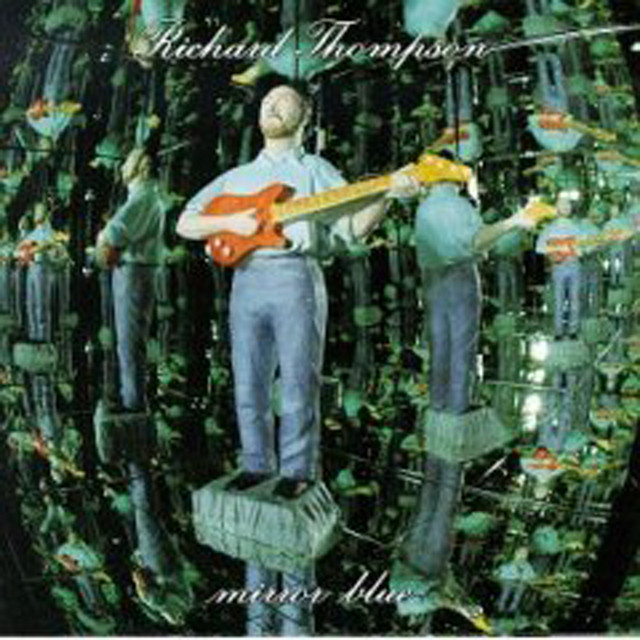
Mirror Blue - Richard Thompson (1994)
This was my intro to Richard Thompson. I had heard a few tracks off the previous album, Rumor And Sigh, but this was the first full CD of his I listened through (after I bought it on a recommendation, sight unheard, from Best Buy; the 90s sucked for efficently discovering new music).
If you never learned anything about Thompson other than this album, it would be a nice addition any early 90s guitar rock collection.
Being a full-band recording, you don’t fully get to hear his other-worldly ability to pick out multiple simultaneous melody and accompaniment lines from just his single guitar, although you do get a good sense of his ability to throw down an amazing electric solo here and there.
Being produced by Mitchell Froom is a different sort of disadvantage. Froom is an award-winning producer with his name on many great albums, but I would say he has always had a bias against letting clean instrument tracks sully his shimmering canvas of effects. The hallmark sound of his work around this time included multiple Thomspon records along with Los Lobos, Suzanne Vega, The Finn Brothers / Crowded House, and Elvis Costello. All of these are great records that seem to go to great lengths to hide the fact that there are actual working musicians creating them, burying the band in room under reverb, compression, chorus effects, and oddball equalizer choices.
The best chances Thompson has of escaping the studio vortext are the solo guitar-and-vocal tracks, which do sound mostly unscathed: King Of Bohemia, and (for the most part) my favorite track Beeswing are both good examples, though Taking My Business Elsewhere can’t quite escape the chimy overtones that hide the fact that Thompson is playing both bass and treble.
The lyrics on an RT record are often humorous but always tend to the acerbic and vicious. I particularly love his ode to media sensationalism and gritty true crime, Shane And Dixie. Elsewhere we get Mingus Eyes, a rumination on a lack of manliness costing our narrator with the ladies.
On the lighter side, Fast Food is an observation on American cuisine and business, and MGB-GT is, as Thompson has said, his ode to the inscrutable songs out of California in his youth celebrating gas-guzzling muscle cars.
Beeswing is the the masterpiece here, both lyrically and musically. It’s one of my favorites of his, and floors me every time I hear it.